What are amps, watts, volts and ohms?
The three most basic units in electricity are
voltage (V)
current (I, uppercase "i")
resistance (r).
Voltage is measured in volts, current is measured in amps and resistance is measured in ohms.
A neat analogy to help understand these terms is a system of plumbing pipes.
The voltage is equivalent to the water pressure,
current is equivalent to the flow rate, and
resistance is like the pipe size.
There is a basic equation in electrical engineering that states how the three terms relate.
It says that the current is equal to the voltage divided by the resistance.
How does this relation applies to the plumbing system.
| Let's say you have a tank of pressurized water connected to a hose that you are using to water the garden.
What happens if you increase the pressure in the tank?
You probably can guess that this makes more water come out of the hose.
The same is true of an electrical system: Increasing the voltage will make more current flow.
Let's say you increase the diameter of the hose and all of the fittings to the tank.
You probably guessed that this also makes more water come out of the hose. This is like decreasing the resistance in an electrical system, which increases the current flow. |
 |
Electrical power is measured in watts.
In an electrical system power (P) is equal to the voltage multiplied by the current.
The water analogy still applies.
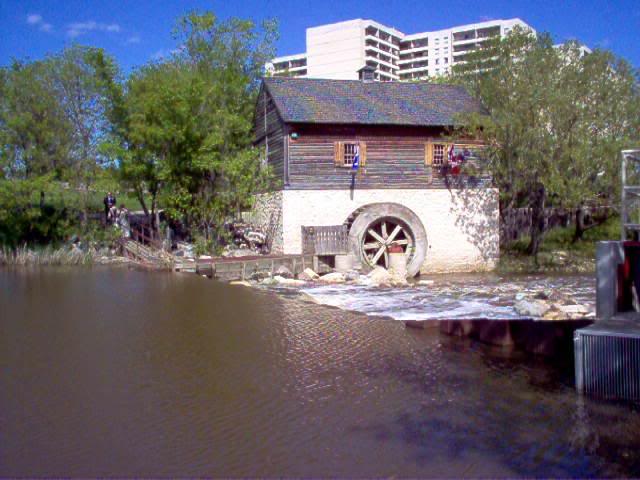
Take a hose and point it at a waterwheel like the ones that were used to turn grinding stones in watermills.
You can increase the power generated by the waterwheel in two ways.
- If you increase the pressure of the water coming out of the hose, it hits the waterwheel with a lot more force and the wheel turns faster, generating more power.
- If you increase the flow rate, the waterwheel turns faster because of the weight of the extra water hitting it.
|
|